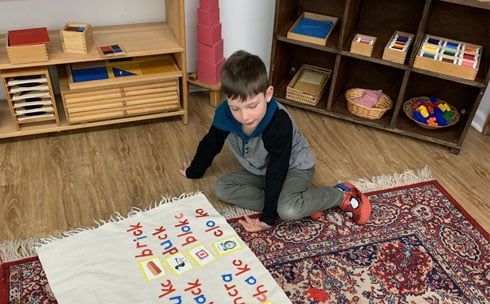

What is the Montessori Approach to Play?
Share this Article:

Montessori schools have been in the United States for generations. These schools were opened beginning in the early 20th century based on a learning method developed by Italian physician Maria Montessori. Montessori schools are noted for their hands-on approach to learning . While most commonly associated with early childhood learning, there are Montessori schools for all ages, from infant programs through high school.
Several recent studies, including one 2017 study published in "The Hechinger Report" concluded that students in Montessori schools scored higher on standardized tests than those in traditional schools. Today, there are more than 2,500 public and private Montessori schools in the United States.
What is the Montessori Theory?
Montessori Theory, created by Dr. Maria Montessori, focuses on child-led learning through hands-on activities. It encourages independence and curiosity by providing a structured yet flexible environment. Kids explore, play, and learn at their own pace, making education natural and engaging
Montessori Activities vs. Open-Ended Play
One of the key differences between a Montessori education and one received at most other schools is the approach to play. Simply put, the Montessori approach to play is learning skills that have a practical application...in a fun way.
According to the movement's founder, Maria Montessori, "Play is the work of the child.” Her vision was to combine play with learning and satisfy a child's curiosity while still allowing them to have fun. Throughout Montessori history, play has been an integral part of the curriculum.
Montessori Approach to Play
The Montessori approach to play has been called "real pretend". In a Montessori classroom, you won't see dress-up games or hear stories about fairies and gnomes. Instead, you'll see kids learning about real-life situations in a playful and fun way.
Open-Ended Play
Unlike Montessori's approach to play, open-ended play is often described as play without any rules or restrictions. With this type of play, there is no right or wrong way to complete a project, and fantasy, such as unicorns or magic kingdoms, is allowed to reign and is even encouraged.
Forms and Types of Montessori Play
The Montessori classroom mimics real life situations more than it resembles a playroom. When you enter a Montessori classroom, you might see a student making snacks for the group, see a student weeding in the community garden, or guiding a younger student who is trying to turn on the tap for a drink of water.
1. Play Is a Process
With Montessori play, activities are fun and done for their own sake, not to accomplish a goal. For example, a child may make a drawing or create a sculpture, not to have something in the end, but because the act of drawing or sculpting is fun. This is even true of "real life" activities, such as learning to wash dishes. Unlike an adult, who washes dishes to get the task done and have a clean kitchen, the child may wash dishes for hours simply because they enjoy it and want to get better at it.
2. Freedom Reigns
At Montessori schools, children get a set amount of time for play activities. Within this timeframe, they get to choose which group activities they want to participate in, if any. They aren't told how long they must stick with a given activity and can quit at any time. Children are never forced to do anything. If a teacher suggests an activity, the child may politely say that it isn't something they want to do. By giving children more freedom, children look forward to playing.
3. Room for Imagination
While fantasy doesn't play a role in Montessori education , that doesn't mean there isn't room for a child's imagination. For example, they can imagine how children in other countries live and do tasks like they do or they can imagine how people 100 or 200 years ago lived. Imagination is also useful in finding solutions to problems and in creative ventures like art, drama, and music.
4. Play Isn't Stressful
In too many traditional school playgrounds, there is stress for kids associated with bullying, with not having someone to play with, and with not being familiar or skilled with the playground equipment or games. Many of us remember the humiliation of being chosen last for a kickball team. Rather than being tense and high-energy , playtime at a Montessori school is focused, purposeful and quiet. That quiet atmosphere is actually a product of children being engaged in their activity. Maria Montessori once said, "The child who concentrates is immensely happy.”
Examples of the Montessori Approach to Play
So, what does play look like at a Montessori school? Below are a few examples...
1. Planting and tending a garden.
2. Walking on the school property and learning to identify trees, plants, flowers, and insects
3. Sharing information they have just learned or read about with another student
4. Creating art using a number of media, such as crayons, clay, paint, paper, and chalk
5. Learning about the school kitchen, making snacks for other students, and cleaning up the kitchen after snack time
6. Learning and performing cleaning tasks, such as cleaning windows, doing laundry, or washing dishes
7. Learning geography by "solving" puzzle maps
8. Playing with dressing frames to learn things like how to use a zipper, how to button a shirt, and how to fasten and unfasten a buckle
As you can see, all of these activities have a practical application and involve learning while still being fun for the child. Not all of these activities are appropriate for all ages. Children are encouraged to try increasingly difficult tasks to challenge themselves, but as discussed above, the decision of what activities to do rests with the individual child .
To learn more about the Montessori philosophy of play and whether Montessori schools are the right choice for your child , visit or contact us today.